Showing posts with label assignment 2. Show all posts

Friday, 3 June 2011

Assignment 2 - Reprise

After receiving my tutors comments - quick as before and much thinking these are the changes I have come up with:

Two points:
A blown highlight, actually very difficult to deal with, and I considered ditching the image altogether and looking for another one, but in the end managed this.

Two flowers, lit from behind. ISO 200, 90mm efl, f/5.6, 1/60 sec

Distinct and irregular shapes:
I found this one particularly difficult, and there has been some discussion on the flickr site about exactly this point.

(http://www.flickr.com/groups/ocarts/discuss/72157626652877693/)

I think this fits the remit, but am still considering it.

Springtime, ISO 100, 90mm efl, f/2.9, 1/250 sec


or this:
Stunning colour, ISO 100, 302mm efl, f/5.6, 1/250 sec
or possibly either of the almost ovals I looked at before.

Implied Triangles:
I had another look at these as I had looked for triangles that were rather less obvious (this is really a problem I am going to have to deal with), and came up with these variants:

Frilly Tulip. ISO 125, 90mm efl, f/3.5, 1/40 sec

Aliens? ISO250, 72mm efl, f/5.6, 1/50 sec

I suppose thwere are less changes this time, but I have more confusion about the final choices, I think I am going to have to proint them off and then decide.

Wednesday, 18 May 2011

Assignment 2 - part 3

Distinct, even if irregular, shapes.

This is the grouping that could hols all those lovely images of single flowers against a blurred out background Moderation is required here. I needed to look for flowers that showed a definite shape.

Tulip After Rain. ISO 100, 90mm efl, f/2.8, 1/125 sec.


An almost regular oval, I almost choose this for a single point, but I think it is too large. The contrasting colours here help to define the shape.


Magnolia Bud. ISO 400, 400mm efl, f/11, 1/50sec.


Another almost oval image, this one slightly less regular.


Repeated circles. ISO 100, 90mm efl, f/7.1, 2 secs.


Repeated circles , followed though in the petals. I thought this showed 'round' better than the whole flower, which is itself round.


The last image encapsulates the concept of 'roundness' or 'circularity' without focusing on the entire flower.

At least two kinds of implied triangle.

This one I initially found hard as I wsa trying to find 2 triangle that were different in one image. Following advice from my tutor I started looking for 2 images to show this

Colour After a Storm. ISO 100, 90mm efl, f/5 1/8 sec.


I went outside one morning and found this solitary tulip which has survived our unexpectedly severe winter. The colour really was this shocking!


Aliens?  ISO 250, 72mm efl, f/5.6, 1/50 sec.


This was found in our local botanic garden. I have no idea what plant it is, but it does show 2 triangles.


Tiny Beauty. ISO 400, 82mm efl, f/5.6, 1/60 sec.


This flower was very small, about 2cms at its widest point.


The second and third images show implied triangles, while the first is a definite triangle in itself.

Rhythm.

If this had been on lanscapes I would have been able to fill a book, however much harder when concentrating on plants.

Reeds in the Wind. ISO 250, 200mm efl, f/9, 1/250 sec.


The curved shapes formed by the reeds blowing in a strong wind leads the eye acros the picture. Tension is set up because the picture leads you from right to left, not the more usual left to right.


Avenue of Trees. ISO 100, 90mm efl, f/9, 1/80 sec


 The repeated trees draw the eye across the image to the barely visible figure in blue at the end of the path.


This is a difficult choice - but overall I think the reeds illustrate the concept more clearly.


Pattern.

Rock Plant.  ISO 100, 90mm efl, f/5.6, 1/60 sec.


Looking into the center of any flower will often show a pattern, but this succulent plant shows a very regular pattern.


Cactus. ISO 100, 90mm efl, f/3.5, 1/400 sec.


This spiky cactus is so regular that it could be man-made, but is is one of natures more effective defences against predation.


Here the cactus shows a regular pattern that, without knowing the source, could be anything. The emphasis is clearly on the pattern and not on the underlying plant.


This was a fascinating assignment. On reviewing all the images that I chose two things stood out.:
  1. A very high proportion were taken with my prime 45mm (90mm efl) lens.
  2. A lot of the images could have been used to show several categories.

Assignment 2- part 2

A combination of vertical and horizontal lines.

When looking for suitable images here I discovered that I had a large number that showed angled lines, but not truly horizontal, and also a large number of landscape images, where the main  horizontal marker was the horizon, there were far fewer where the lines came from the plants. I assume that this is because nature does not use true horizontal and vertical often (except in trees)

Last Years Seeds.  ISO 100, 310mm efl, f/5.2, 1/125 sec.


Old seed pods from last year caught against a deep blue sky, forming a cross pattern.


Birch Bark. ISO 100, 122mm efl, f/11, 1/80 sec.


I find trees, their shapes and especially their bark endlessly fascinating. This shows the paper thin torn outer bark of a birch tree causing a clear horizontal pattern.


My preferred image here is the tree as I find the contrast of an upright tree showing as secondary to the horizontal lines interesting.

Diagonals.

Heart of a Lily. ISO 100, 68mm efl, f/7.1, 1/400 sec.


A simple image of the lily with the diagonal of the central spadix echoed by the diagonals in the petal.


Fern.  ISO 250, 90mm efl, f/5.6, 1/60 sec.


Here the diagonal pattern of the fern leaves is exaggerated by looking into the centre of the plant.


My preference here is for the lily, but the fern does show a better effect of the diagonals leading the eye.

Curves.

The main problem here was choice, or to be accurate, too much choice. Plants are curvy, the leaves curve, the stems curve and the petals curve.

Where Does it Lead?  ISO 100, 90mm efl, f/5.6, 1/50sec.


I love this picture of the curving path -but unfortunately it does not really follow the rules in that it is a landscape, rather than individual plants.


Spring Blossom. ISO 100, 90mm efl, f/6.3, 1/200sec.


A very typical picture of a branch of spring blossom with the curve of the branch copied by the curves of the leaves and petals.


Stamens. ISO 100, 90mm efl, f/6.3, 1/200 sec.


Looking right into the cenyre of a lily. This was originally deep red, but he curves are emphasised in the monochrome conversion.


Uncurling! ISO 400, 90mm efl, f/5.6, 1/60 sec


An as yet unculed fern bract. Curls in all directions.


I enjoy all these images but the last shows curves in all the possible directions.


Tuesday, 17 May 2011

Assignment 2

When I initially looked at this assignment I thought it would be relatively simple as I take pictures of plants and flowers all the time but:
  • I am still working on the principle of only using photos taken since I started this course, and preferably ones specifically for this assignment
  • The weather has not been very helpful
  • I am not good at taking photos to order. Most of my most prized images turned out to be unsuitable as they did not show the specific points asked for.
So for this learning log I have tried to cut down the possible images to only 2 (or occasionally 3) per subject, of which I will send my tutor 1. Alan advised that that a small number of the best  imagesI can manage was much better than larger numbers with potentially poor images.

A single point dominating the composition.

I have many flower and plant images with a single flower, but in most cases the flower takes up the majority of the space available, and therefore could not be described as a point, and do not demonstate the idea of the impact that a relatively small point object can have.

Tulip in the Wild.  ISO 400, 400mm efl, f/5.6, 1/100sec.


This was taken latish one evening walking along the path at the end of our street, a solitary tulip in the rough edge of the path. The light was not very good, but the sudden burst of colour caught my eye.


Daisy. ISO 250, 400mm efl, f/9, 1/250 sec.


A randomly found daisy alongside a path. This was deliberately taken for this exercise, a very small flower in a large expanse of green.


Both these show a clear single point, my preference is for the tulip, but I like both images.

Two points.

This should be simple, but in practice I discovered that either the 2 points were to close together  (or even touching) or that there were far more points evident when I examined the photo carefully.

Californian Poppies. ISO 100, 90mm efl, f/5.6, 1/60 sec.


 A flower and a bud. I originally liked this image a lot, but then the stalk of the bud appearing out of the flower started to feel awkward to me. I would have also preferred for the secondary subject  to be less central.


 Brilliance. ISO 200, 90mm efl, f/5.6, 1/60 sec


Two more yellow flowers. Here the petals are so thin that they are almost translucent, again the bud stalk grows out of the flower head, but it is less intrusive.


I prefer the second image here. This illustrates how carefully you have to look all around the main object for intrusive happenings.

Several points in a deliberate shape.

I found this part particulaly challenging partly because I initially read it slightly wrongly. I started by looking for a number of points present in an image that formed a deliberate shape such as flower buds in a circle, or the stamens in the centre of a flower.

Lily Stamens.  ISO 400, 90mm efl, f/22, 1/4 sec.


These stamens form an almost circular pattern, but it is made by nature, and not by man.


Flower Arrangement - black and white. ISO 400, 45mm efl, f/8, 0.4 sec.


I then tried various flower arrangements, but was not particularly happy about any of then. Oddly enough, those that looked best as an arrangment photographed least well in this context, I think because in an arrangement one tends to avoid a deliberate looking shape.  This was a pleasing triangle of flowers, and I found the monochrome conversion fun.


I then took a completely different approach and took a group of found natural objects, a piece of wood, several pinecones and some flowers and built an arrangement from the bottom up, gradually adding extra items.

Seadrift and Pinecones. ISO 160, 90mm efl, f/5.6, 1/60 sec.


The original version, end result of gradually building up items, removing some and readjusting.
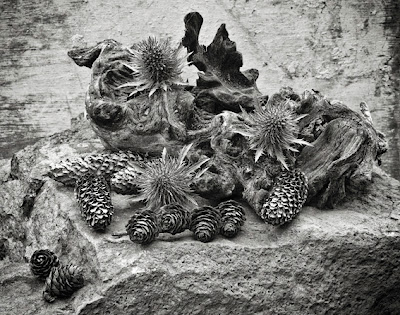


Seadrift and Pinecones (monochrome). ISO 160, 90mm efl, f/5.6, 1/60 sec


And a monochrome version with a sepia tint.


The coloured version here is my preferred option, as I feel it fulfills the requirements of forming a deliberately arranged shape, while producing an interesting image.